Financing

Paying for community college can be overwhelming. Use the tools, resources and tips within this section to help you finance your education. From student loans to scholarships, we’ll cover the most common financial aid options available to community college students. Get money saving tips, learn more about Pell grants, and explore the federal work-study program.

View the most popular articles in Financing:

2026 Community College Tuition: National Cost Guide

Updated
|
2026 Community College Tuition: National Cost Guide
A 2026 breakdown of community college tuition nationwide, including state comparisons, fees, and total cost of attendance.

Community college tuition remains one of the most affordable entry points into higher education in 2026. As families weigh rising university prices against workforce demands and transfer pathways, two-year public colleges continue to offer strong academic value at a fraction of the cost of four-year institutions.

This updated 2026 community college tuition guide breaks down national averages, state-by-state variations, total cost of attendance, and key trends shaping affordability this year. Whether you are planning a transfer to a four-year university or pursuing a workforce credential, understanding the full cost picture is essential.

2026 National Average Community College Tuition

According to the most recent data from the National Center for Education Statistics, the national average in-district tuition and required fees at public two-year institutions has remained relatively stable in inflation-adjusted dollars over the past decade.

For the 2025 to 2026 academic year, national averages are approximately:

Student Type Average Tuition & Fees
In-district (local) $3,900 per year
In-state (same state) $5,100 per year
Out-of-state $8,600 per year

While modest increases have occurred in certain states due to funding shifts and inflation pressures, community colleges continue to cost significantly less than public four-year universities, where average in-state tuition exceeds $10,000 annually.

Understanding In-District vs. In-State Tuition

One factor that makes community college tuition uniquely affordable is the in-district rate. Students who reside within a community college’s taxing district pay the lowest tuition.

Key distinctions:

  • In-district tuition: For students living

. . .read more

Transportation Challenges for Community College Students in 2026

Updated
|
Transportation Challenges for Community College Students in 2026
Explore transportation challenges for community college students in 2026 and affordable solutions including transit passes, micro-mobility, and hybrid learning.

Transportation Challenges for Community College Students: Affordable Solutions in 2026

Transportation challenges for community college students remain one of the most persistent and underexamined barriers to college access and completion. In 2026, rising housing costs, expanding suburban campuses, and continued enrollment growth have made transportation challenges for community college students more complex than ever. For many learners, transportation challenges for community college students directly affect attendance, academic performance, and retention.

Community colleges enroll nearly half of all undergraduate students in the United States, many of whom balance school with work and family responsibilities. Transportation challenges for community college students are especially acute because these institutions often serve older students, first-generation learners, and students from lower-income households. Addressing transportation challenges for community college students is now a priority for campus leaders, policymakers, and regional transit agencies.

This article examines the transportation challenges for community college students in 2026 and highlights affordable, scalable solutions that colleges are adopting nationwide.

Why Transportation Challenges for Community College Students Persist

Transportation challenges for community college students differ from those faced by students at residential four-year institutions. Most community college students commute, often long distances, using a mix of personal vehicles, public transit, and informal ride arrangements.

Key factors driving transportation challenges for community college students include:

  • Limited public transit routes serving suburban or rural campuses

  • Rising fuel, insurance, and vehicle maintenance costs

. . .read more

January-Start Students, Credit Load and Financial Aid

Updated
|
January-Start Students, Credit Load and Financial Aid
What January-start students should know about credit load requirements and financial aid eligibility in 2026.

What January-Start Students Should Know About Credit Load & Financial Aid Eligibility

January-start students are a growing population at community colleges nationwide. Whether enrolling after a midyear move, returning from work or military service, or starting college later than planned, January-start students often face different academic and financial aid considerations than fall enrollees.

Understanding how credit load affects financial aid eligibility is critical for January-start students. Missteps in course selection can delay aid, reduce award amounts, or affect future eligibility. With updated federal guidance in place for the 2025–2026 and 2026–2027 academic years, January-start students should approach enrollment with a clear plan.

This guide explains how credit load works, how financial aid eligibility is calculated, and what January-start students can do to protect their funding.

Why Credit Load Matters for January-Start Students

For January-start students, credit load determines whether financial aid is disbursed at full, partial, or minimal levels. Most federal and state aid programs are tied to enrollment intensity, not simply admission status.

January-start students often enroll in the spring term as part of the same academic year that began in the fall. That timing can affect remaining eligibility for grants and loans already partially used by fall enrollees.

Key reasons credit load matters for January-start students include:

  • Federal Pell Grant awards are prorated by enrollment level.

  • Federal student loans require minimum half-time enrollment.

. . .read more

Average Community College Tuition Cost 2026 Update

Updated
|
Average Community College Tuition Cost 2026 Update
Explore updated 2026 community college tuition averages, cost trends, planning tips, admissions timing advice, and financial strategies for families and students.

Average Community College Tuition Cost Update 2026

Community colleges remain one of the most affordable pathways to higher education in the United States, offering a lower‑cost alternative to four‑year universities while providing career training, transfer opportunities, and flexible scheduling. For parents and students planning ahead for the 2025–26 academic cycle, it is vital to understand what tuition costs look like today, how they compare with past years, and how non‑tuition expenses and financial planning affect overall affordability.

Current National Tuition Averages

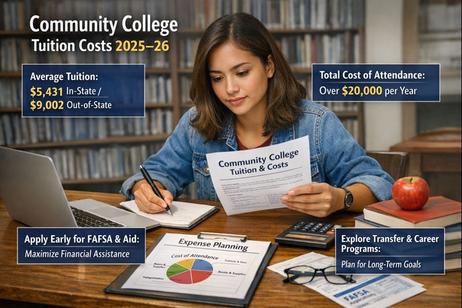
For the 2025–26 academic year, recent data indicate that public community college tuition averages approximately $5,431 per year for in‑state students and $9,002 per year for out‑of‑state students. This reflects slight year‑to‑year increases at many institutions but continues to be significantly lower than tuition at four‑year colleges and universities.

These figures are consistent with broader tuition reporting that places community college tuition in the $5,000–$8,800 range nationally, depending on residency status and institutional policies.

Understanding Tuition Variability by State and Residency

One key characteristic of community college costs is wide state variation. In states like California and New Mexico, in‑district tuition can be as low as $1,440–$2,250 per year, whereas in high‑cost states such as Vermont, published tuition can approach $8,900 annually.

Residency also plays a major role. Students qualifying for in‑district or in‑state tuition pay significantly less than out‑of‑state or out‑district students, who often see tuition costs nearly double the in‑district rate.

As an example, the average tuition

. . .read more

Community College Scholarships with January Deadlines 2025–26

Updated
|
Community College Scholarships with January Deadlines 2025–26
Explore community college scholarships with January deadlines for 2025–26, including eligibility tips, award amounts, and planning strategies.

Community College Scholarships with January Deadlines: 2025–26 List

January is one of the most important months on the financial aid calendar for community college students. While many learners associate scholarship season with spring, a significant number of high-value awards close in January. Missing these deadlines can mean losing access to thousands of dollars in grant aid that does not need to be repaid.

This guide highlights major community college scholarships with January deadlines for the 2025–26 academic year, explains who should apply, and offers practical strategies for staying competitive. Parents, students, and counselors will find actionable insights to help maximize funding opportunities early in the year.

Why January Matters for Community College Scholarships

January deadlines tend to be associated with national and foundation-funded scholarships that require longer review periods. These awards often support high-achieving students, transfer-bound learners, and those with financial need or leadership experience.

For community college students, January is especially critical because:

  • Many transfer scholarships require early selection cycles.

  • Academic honor societies finalize nominee lists during winter term.

  • Scholarship committees want fall semester grades included.

  • FAFSA completion often aligns with January planning timelines.

Students who prepare applications during the fall term are best positioned to compete for these limited and often generous awards.

Major Community College Scholarships with January Deadlines (2025–26)

Below is

. . .read more

Recent Articles

Test Article, Image and Content
Test Test Test Test Test Test Test Test Test Test Test Test Test Test Test Test Test Test Test Test Test Test Test Test Test Test Test Test Test Test Test Test Test Test Test Test Test Test Test Test Test Test Test Test Test Test Test Test Test Test Test Test Test Test Test Test Test Test Test Test Test Test Test Test Test Test Test Test Test Test Test Test Test Test Test Test Test Test Test Test Test Test Test Test Test Test Test Test Test Test Test Test Test Test Test Test Test Test Test Test Test Test Test Test Test Test Test Test Test Test Test Test Test Test Test Test Test Test Test Test Test Test Test Test Test Test Test Test Test Test Test Test Test Test Test Test Test Test Test Test Test Test Test Test Test Test Test Test Test Test Test Test Test Test Test Test Test Test Test Test Test Test Test Test Test Test Test Test Test Test Test Test Test Test Test Test Test Test Test Test Test Test Test Test
Faith Formation Integrated Across Subject Areas
Explore faith formation integrated across subject areas and its impact on curriculum, student outcomes, and community colleges.
Parish-Based Governance Models in Catholic Schools
Explore parish-based governance models in Catholic schools and their impact on leadership, funding, and community colleges.

Financing

FINANCING BASICS
Build the foundation needed to navigate the community college financial aid system. Learn which schools are the most affordable, get money tips on reducing college costs, and explore the latest initiatives to make community colleges even more accessible.
TUITION
This section will help you prepare for the costs of attending community college and any future increases. Explore pricing plans, learn where you may be able to attend community college tuition-free, and examine the latest initiatives to make higher education more affordable.
FINANCIAL AID
Our articles will provide you with the tools and resources needed to make sure you are qualifying for all the financial aid available, as well as maintaining your aid throughout your college career. Get the latest news on student loan interest rates, learn what to do when your financial aid is late, and explore all of your financial aid options.
SAVING MONEY
This section is full of money saving tips for community college students. From free textbooks to finding affordable childcare, we’ll provide you with a wealth of information on keeping college affordable.
GRANTS & SCHOLARSHIPS
There's nothing better than free money, and these articles can help you get grants and scholarships for your community college education. Acquire information on Pell grants and why you should take advantage of them, learn how you can earn money through community college writing and get the latest news on scholarships and funding.