Understanding How Community Colleges Help Students with Disabilities is essential for families and students evaluating postsecondary options in 2026. With nearly one in five undergraduates reporting a disability, according to the National Center for Education Statistics, community colleges play a critical role in providing accessible, affordable, and flexible higher education pathways.
From academic accommodations and assistive technology to career planning and transition support, community colleges have steadily expanded services designed to ensure students with disabilities can succeed both in the classroom and beyond. For many learners, especially those seeking a supportive environment close to home, these institutions offer a balanced combination of affordability, individualized attention, and practical workforce preparation.
This article explores how community colleges help students with disabilities, what services are typically available, and what families should look for when evaluating programs.
The Legal Foundation: Equal Access in Higher Education
Community colleges operate under federal disability laws that guarantee equal access to education.
Two primary statutes shape campus policies:
The Americans with Disabilities Act
Section 504 of the Rehabilitation Act, administered by the U.S. Department of Education Office for Civil Rights
Unlike K–12 education, where schools must identify and provide services under the Individuals with Disabilities Education Act, college students must self-disclose and request accommodations. Once documentation is provided, institutions are required to offer reasonable accommodations that ensure equal access to academic programs.
In 2026, many community colleges have strengthened compliance efforts by upgrading digital accessibility, increasing staff training, and modernizing accommodation management systems to streamline requests.
Dedicated Disability Support Services Offices
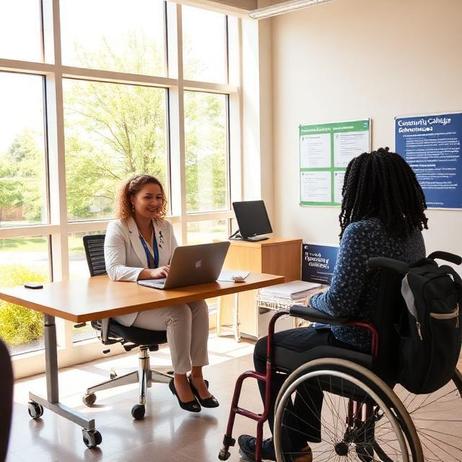
A central feature of how community colleges help students with disabilities is the campus disability support services office, sometimes called accessibility services or student access services.
These offices typically provide:
Academic accommodations
Testing modifications
Note-taking assistance
Sign language interpreters
Alternative format textbooks
Assistive technology access
Faculty coordination and advocacy
Because community colleges often serve smaller class sizes compared to large universities, disability staff can provide more individualized attention. Many campuses now offer hybrid service models, allowing students to request accommodations, submit documentation, and schedule appointments online.
In 2026, several states have introduced centralized digital accommodation portals across community college systems, reducing paperwork and improving response times.
Academic Accommodations in Practice
Understanding how community colleges help students with disabilities requires examining how accommodations function day to day.
Common academic supports include:
Extended time on exams
Reduced-distraction testing environments
Priority registration
Flexible attendance policies when disability-related
Captioned course materials
Accessible lab equipment
Adaptive furniture
Snapshot: Common Accommodation Types
| Disability Category | Typical Accommodations |
|---|---|
| Learning disabilities | Extended testing time, note-taking support, audio textbooks |
| ADHD | Testing adjustments, priority scheduling |
| Physical disabilities | Accessible classrooms, adaptive technology |
| Visual impairments | Screen readers, Braille materials, large-print texts |
| Hearing impairments | Interpreters, CART captioning services |
| Chronic health conditions | Flexible attendance, remote access options |
Importantly, accommodations are not retroactive. Students must proactively engage with disability services early each semester.
Assistive Technology and Digital Accessibility
Technology has significantly reshaped how community colleges help students with disabilities.
Most campuses now provide access to:
Screen readers and magnification software
Speech-to-text programs
Smart pens and digital note tools
Accessible computer labs
Closed-captioned instructional media
Learning management systems optimized for screen readers
In 2026, federal guidance continues to emphasize digital accessibility standards aligned with Web Content Accessibility Guidelines. Community colleges increasingly audit online course materials to ensure compatibility.
Transition Support from High School to College
For many students, community colleges offer a smoother transition from high school than four-year universities.
Key differences include:
Smaller campuses
More flexible course scheduling
Closer proximity to home
Lower tuition costs
Open admissions policies
Disability services offices often host orientation sessions specifically for incoming students with disabilities, explaining:
Differences between IEP/504 plans and college accommodations
Documentation requirements
Self-advocacy expectations
How to communicate with professors
Some community colleges partner with local school districts to create bridge programs that prepare students during their senior year of high school.
The National Center on Educational Outcomes provides research highlighting how structured transition planning improves college persistence for students with disabilities.
Career and Workforce Pathways
One of the strongest examples of how community colleges help students with disabilities lies in career and technical education.
Community colleges offer:
Workforce certificates
Associate degrees
Apprenticeship programs
Industry-aligned credentials
Transfer pathways to four-year universities
For students with disabilities, career-focused programs can provide practical skill development with built-in accommodations. Disability offices often collaborate with career services to ensure:
Accessible internships
Interview preparation support
Resume assistance
Employer disclosure guidance
In 2026, several states have expanded inclusive workforce initiatives, connecting community college students with disability-friendly employers in healthcare, technology, skilled trades, and public service sectors.
Mental Health and Invisible Disabilities
An increasing number of students report anxiety, depression, ADHD, and other invisible disabilities.
Community colleges have responded by:
Expanding counseling services
Integrating wellness programs
Offering flexible attendance accommodations
Training faculty on trauma-informed instruction
Post-pandemic enrollment data continues to show rising mental health accommodation requests. Many campuses now provide telehealth counseling options, making support more accessible for commuting students.
Understanding how community colleges help students with disabilities includes recognizing this expanded focus on mental health support alongside traditional physical and learning disability services.
Financial Accessibility and Affordability
Cost remains one of the most significant barriers to higher education.
Community colleges help reduce financial strain through:
Lower tuition compared to four-year institutions
Federal Pell Grants
State tuition assistance programs
Work-study opportunities
Disability-related scholarships
Students with disabilities may also qualify for vocational rehabilitation services through state agencies, which can assist with tuition, technology, and transportation costs.
The Federal Student Aid office provides detailed guidance on grants and aid eligibility, including considerations for students with disabilities.
Affordability allows many students to attend part time while managing health or mobility needs.
Faculty Training and Inclusive Teaching
Faculty engagement plays a central role in how community colleges help students with disabilities.
In 2026, many colleges provide professional development in:
Universal Design for Learning principles
Accessible syllabus design
Captioning and multimedia accessibility
Flexible course policies
Inclusive classroom communication
Universal Design for Learning emphasizes proactive course design that benefits all students, not just those with documented disabilities.
When accessibility is built into course design from the start, fewer individual accommodations are needed.
What Families Should Ask When Evaluating a College
Prospective students and families should ask targeted questions during campus visits or virtual information sessions.
Consider asking:
How many staff members work in disability services?
What is the average turnaround time for accommodation approvals?
Are online courses fully accessible?
Is assistive technology available on campus?
What documentation is required?
Are there transition programs for first-year students?
Community colleges vary in resources, so researching specific campuses is essential.
Frequently Asked Questions
Do students need an IEP in college?
No. IEPs do not transfer to college. Students must provide updated documentation and request accommodations through the disability services office.
Are accommodations guaranteed?
Colleges must provide reasonable accommodations under federal law, but adjustments cannot fundamentally alter course requirements.
Can students receive accommodations in online classes?
Yes. Digital accessibility standards apply to online courses, and students can receive accommodations such as extended testing time and captioning.
Is community college a good first step before transferring to a university?
For many students with disabilities, yes. Community colleges often provide a supportive environment to build academic confidence before transferring.
Conclusion: Why Community Colleges Matter
Understanding How Community Colleges Help Students with Disabilities reveals why these institutions are central to equitable access in American higher education.
Through dedicated disability services offices, individualized accommodations, assistive technology, mental health support, and workforce preparation, community colleges offer structured yet flexible pathways to success.
In 2026, as enrollment patterns continue shifting and accessibility expectations rise, community colleges remain uniquely positioned to meet students where they are, academically, financially, and personally.
For families seeking an affordable, supportive, and inclusive starting point, community colleges deserve serious consideration.