Tuition

This section will help you prepare for the costs of attending community college and any future increases. Explore pricing plans, learn where you may be able to attend community college tuition-free, and examine the latest initiatives to make higher education more affordable.

View the most popular articles in Tuition:

Tuition-Free Community College Programs by State

Updated
|
Tuition-Free Community College Programs by State
Explore tuition-free community college programs in 2026, including which states offer them and how students can qualify.

Tuition-free community college programs have moved from pilot initiatives to a central feature of higher education policy across the United States. As of 2026, more states are investing in “last-dollar” and “first-dollar” scholarship models designed to make two-year degrees accessible without the burden of tuition costs.

For families navigating rising college expenses, understanding where tuition-free community college programs exist, how they work, and who qualifies is increasingly important. While “free college” rarely covers every cost, these programs significantly reduce financial barriers and expand access to workforce-ready credentials.

This guide examines the growth of tuition-free community college programs, highlights states currently offering them, and explains what prospective students should know before applying.

What Does “Tuition-Free” Really Mean?

Despite the appealing label, tuition-free programs vary widely in structure. Most fall into two categories:

Last-dollar programs

  • Cover remaining tuition after federal and state grants are applied
  • Often require FAFSA completion
  • May not cover fees, books, or living expenses

First-dollar programs

  • Cover tuition upfront before other aid is applied
  • Allow students to use federal aid for additional expenses
  • Less common, but growing in popularity

According to the National Center for Education Statistics, average community college tuition remains relatively low compared to four-year institutions, but total costs still present barriers for many students. Tuition-free programs aim to close that gap.

Why States Are Expanding Free Community College

Several forces are driving the rapid expansion of these programs:

Workforce Demand

States are facing shortages in skilled labor sectors such as
. . .read more

Average Community College Tuition Cost 2026 Update

Updated
|
Average Community College Tuition Cost 2026 Update
Explore updated 2026 community college tuition averages, cost trends, planning tips, admissions timing advice, and financial strategies for families and students.

Average Community College Tuition Cost Update 2026

Community colleges remain one of the most affordable pathways to higher education in the United States, offering a lower‑cost alternative to four‑year universities while providing career training, transfer opportunities, and flexible scheduling. For parents and students planning ahead for the 2025–26 academic cycle, it is vital to understand what tuition costs look like today, how they compare with past years, and how non‑tuition expenses and financial planning affect overall affordability.

Current National Tuition Averages

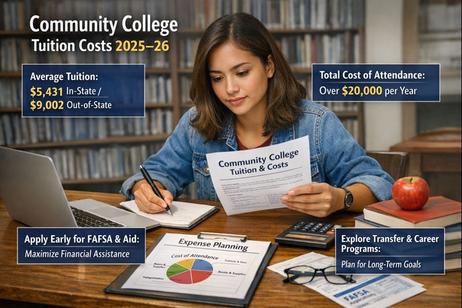
For the 2025–26 academic year, recent data indicate that public community college tuition averages approximately $5,431 per year for in‑state students and $9,002 per year for out‑of‑state students. This reflects slight year‑to‑year increases at many institutions but continues to be significantly lower than tuition at four‑year colleges and universities.

These figures are consistent with broader tuition reporting that places community college tuition in the $5,000–$8,800 range nationally, depending on residency status and institutional policies.

Understanding Tuition Variability by State and Residency

One key characteristic of community college costs is wide state variation. In states like California and New Mexico, in‑district tuition can be as low as $1,440–$2,250 per year, whereas in high‑cost states such as Vermont, published tuition can approach $8,900 annually.

Residency also plays a major role. Students qualifying for in‑district or in‑state tuition pay significantly less than out‑of‑state or out‑district students, who often see tuition costs nearly double the in‑district rate.

As an example, the average tuition

. . .read more

Community College Cost vs Private College Cost: What Families Should Compare

Updated
|
Community College Cost vs Private College Cost: What Families Should Compare
Explore community college vs. private college costs in 2025, what families should compare — tuition, aid, net price, value, and ROI.

Community College vs. Private College Costs: What Families Must Weigh

When families begin planning for higher education, one of the most consequential decisions is cost. In 2025, rising tuition, living expenses, and the complexity of financial aid make it more important than ever to compare apples to apples. This article lays out the key components and trade-offs families should analyze when comparing community college costs to private college costs.

1. Understanding the Sticker Price: What Are You Paying?

Community College (Public 2-Year)

  • For the 2024–25 academic year, the average tuition and fees at U.S. public community colleges are approximately $4,050 annually. Center for American Progress

  • Some sources estimate the in-district rate just over $3,780, while out-of-state tuition averages around $8,784. Community College Review

  • Community colleges often price tuition at only ~35% of what in-state public four-year institutions charge. AACC

  • According to CommunityCollegeReview, one estimate for 2025 shows in-state community college tuition around $5,238, with out-of-state at $8,895. Community College Review

Private (Nonprofit Four-Year)

  • The average private nonprofit college’s sticker tuition, fees, room and board hover around $38,421 + other expenses = ~$58,628/year in many instances. Education Data Initiative

  • Some recent analyses show private college tuition sticker prices reaching $43,350 for 2024–25.

. . .read more

Hidden Costs of Community College in 2025

Updated
|
Hidden Costs of Community College in 2025
Explore the full cost of community college in 2025—from tuition to hidden expenses—offering parents and students clear insight into affordability.

Attending a community college often has the reputation of being an affordable gateway to higher education and workforce training. But the truth is more nuanced. In 2025, the turn-key cost of enrolling in a two-year institution still conceals a range of “hidden” expenses—books, fees, housing, transportation, child care—that significantly affect student success. For parents, students and educators, gaining full visibility into these costs is critical.

This updated article draws from the original structure on BoardingSchoolReview’s partner site Community College Review but refreshes the data, policy context and practical advice to reflect 2025 realities.

1. Tuition and fees: still low but rising for some

One of the enduring advantages of community colleges is their relatively modest tuition and fees compared with four-year institutions. According to the U.S. Department of Education, in 2021-22 the average in-district tuition for a full-time student at a public two-year college was $3,307 with required fees of $671.
However, more recent estimates show that tuition and fees alone do not paint the full picture.

A 2025 breakdown from EducationData reports the average tuition and fees for a full-time in-district student at a community college at about $3,890 annually (in-district) and roughly $9,250 for out-of-state students. Education Data Initiative Meanwhile, another source estimates the average cost of attendance (tuition + fees + living costs) for a community college student in 2025 is about $7,780 per year.
What this means: yes, tuition remains comparatively affordable, but families should be

. . .read more

2025 Community College Tuition Trends | What Parents Should Know

Updated
|
2025 Community College Tuition Trends | What Parents Should Know
Explore 2025 trends in community college tuition, what drives cost changes, and tips parents can use to plan wisely.

2025 Community College Tuition Trends: What Parents Should Know

As parents and guardians help their students prepare for post-secondary education, understanding tuition trends at community colleges has never been more important. In 2025, the landscape for two-year institutions is evolving: tuition remains relatively modest compared to four-year colleges, but cost-pressures, changing student demographics, and institutional responses are shaping what families should expect. This article provides a clear, up-to-date look at community college tuition trends, how they impact families, and actionable advice for navigating the choices.

Why community college tuition matters

For many families, enrolling at a community college is a practical first step toward a degree, certificate, or transfer to a four-year university. Because community colleges often allow full-time or part-time attendance, local commuting, and lower tuition, they can reduce the total cost of post-secondary education.

Key reasons tuition trends matter:

  • Tuition affects upfront affordability and influences student debt.

  • Tuition growth (or the lack thereof) signals how accessible education remains.

  • Tuition combined with living, transportation, and books gives a fuller cost picture.

  • Awareness of tuition trends allows families to budget, apply for aid, and plan alternatives.

In short: understanding what tuition is doing at community colleges helps parents and students make informed decisions.

Current national tuition trends for community colleges (2024–25 & 2025)

What the numbers

. . .read more

Recent Articles

Test Article, Image and Content
Test Test Test Test Test Test Test Test Test Test Test Test Test Test Test Test Test Test Test Test Test Test Test Test Test Test Test Test Test Test Test Test Test Test Test Test Test Test Test Test Test Test Test Test Test Test Test Test Test Test Test Test Test Test Test Test Test Test Test Test Test Test Test Test Test Test Test Test Test Test Test Test Test Test Test Test Test Test Test Test Test Test Test Test Test Test Test Test Test Test Test Test Test Test Test Test Test Test Test Test Test Test Test Test Test Test Test Test Test Test Test Test Test Test Test Test Test Test Test Test Test Test Test Test Test Test Test Test Test Test Test Test Test Test Test Test Test Test Test Test Test Test Test Test Test Test Test Test Test Test Test Test Test Test Test Test Test Test Test Test Test Test Test Test Test Test Test Test Test Test Test Test Test Test Test Test Test Test Test Test Test Test Test Test
Faith Formation Integrated Across Subject Areas
Explore faith formation integrated across subject areas and its impact on curriculum, student outcomes, and community colleges.
Parish-Based Governance Models in Catholic Schools
Explore parish-based governance models in Catholic schools and their impact on leadership, funding, and community colleges.