Students graduating high school in 2026 have more education pathways than ever before. Two of the most practical and career-focused options are community colleges and trade schools. Both promise faster entry into the workforce than traditional four-year universities, often at significantly lower cost.
However, choosing between them is not always straightforward. Each pathway offers different advantages in terms of career flexibility, job placement, earning potential, and long-term educational opportunities.
This article compares community college and trade school education in 2026, helping families and students determine which route may lead to stronger employment outcomes. While forward-looking discussions in education often highlight themes such as “The Future of Boarding Schools: Emerging Trends to Watch for 2030,” similar questions about workforce readiness and career preparation are shaping decisions in the community college and technical training sectors today.
Understanding Community Colleges
Community colleges are two-year public institutions that provide academic degrees, technical training, and pathways to four-year universities.
Students typically pursue:
Associate of Arts (AA) or Associate of Science (AS) degrees
Associate of Applied Science (AAS) career programs
Certificates in technical fields
Transfer programs to universities
According to the National Center for Education Statistics, community colleges enroll millions of students each year and play a major role in workforce development across the United States.
Key characteristics include:
Broad academic and career program offerings
Lower tuition compared with four-year universities
Flexible scheduling for working adults
Transfer pathways to bachelor's degree programs
Many students choose community college because it keeps multiple career and education options open.
Understanding Trade Schools
Trade schools, also called vocational or technical schools, focus on preparing students for specific skilled careers. Programs are usually shorter and more specialized than community college programs.
Common trade school programs include:
Welding
HVAC technology
Automotive repair
Electrical work
Plumbing
Medical assisting
Cosmetology
These programs often take between 6 months and 24 months to complete.
Unlike community colleges, trade schools typically emphasize hands-on training with minimal general education coursework.
2026 Workforce Trends Shaping Both Paths
Demand for skilled workers continues to rise across many industries.
The U.S. Bureau of Labor Statistics reports that several technical occupations are projected to grow faster than average through the end of the decade, including:
Wind turbine technicians
Solar photovoltaic installers
HVAC technicians
Electricians
Medical technicians
These fields often require specialized training rather than a traditional bachelor's degree.
This shift toward skills-based hiring has increased the value of both community college and trade school education.
Community College vs Trade School: Key Differences
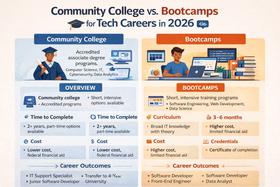
The table below highlights the major distinctions between the two pathways.
| Feature | Community College | Trade School |
|---|---|---|
| Program Length | 2 years (associate degree) | 6–24 months |
| Curriculum | Mix of academics and technical training | Highly specialized job training |
| Cost | Generally low tuition | Varies, sometimes higher for private programs |
| Transfer Options | Can transfer to a 4-year university | Rarely transferable |
| Career Flexibility | High | Limited to trained trade |
| Learning Style | Classroom + labs | Primarily hands-on training |
Both routes can lead to strong employment outcomes, but they serve different types of students.
Cost Comparison in 2026
Affordability remains a major factor for many families.
Average annual tuition estimates:
| Institution Type | Average Annual Tuition |
|---|---|
| Community College (public, in-district) | $3,500–$4,500 |
| Trade School | $5,000–$20,000 depending on program |
Community colleges are typically more affordable, especially when students qualify for federal financial aid.
Programs such as Pell Grants and state workforce initiatives have expanded in recent years, helping reduce education costs for technical fields.
Students can explore financial aid through the Federal Student Aid program.
Job Placement and Career Outcomes
Trade schools often emphasize rapid job placement.
Because their programs are narrowly focused, graduates frequently enter the workforce immediately after completing training.
Many programs include:
Apprenticeships
Employer partnerships
Certification preparation
Community colleges also support career placement, but their programs sometimes involve broader coursework before entering a specific career field.
However, associate degree holders may qualify for a wider range of positions over time.
Research from the Georgetown University Center on Education and the Workforce shows that many associate degree programs lead to strong earnings, particularly in technical and healthcare fields.
Examples include:
Dental hygiene
Radiation therapy
Computer networking
Nursing
These programs often produce salaries that rival some bachelor's degree careers.
Career Flexibility Over Time
One of the biggest differences between the two options is long-term flexibility.
Trade school graduates typically enter a single specialized profession. While this can lead to stable employment, switching careers later may require retraining.
Community college graduates often have more flexibility because they earn transferable academic credits.
For example:
A student may start in an associate degree program in information technology and later transfer to a university to complete a bachelor's degree in cybersecurity.
This flexibility is one reason many counselors recommend community college for students who are still exploring career interests.
Apprenticeships and Industry Partnerships
In 2026, apprenticeships are playing an increasing role in technical education.
Programs registered through the U.S. Department of Labor Apprenticeship Program combine paid work experience with classroom training.
Both trade schools and community colleges are expanding apprenticeship partnerships with industries such as:
Manufacturing
Construction
Renewable energy
Healthcare technology
This hybrid approach allows students to earn wages while learning.
Who Should Choose Trade School?
Trade school may be the better option for students who:
Want to enter the workforce quickly
Prefer hands-on learning over academic coursework
Have a clear career goal in a specific trade
Are comfortable specializing early
For example, a student who knows they want to become an electrician or HVAC technician may benefit from the focused training of a trade school.
Who Should Choose Community College?
Community college may be the better option for students who:
Want to keep academic and career options open
May eventually pursue a bachelor's degree
Are interested in healthcare or technology fields
Prefer a mix of classroom learning and practical training
Many students also use community college as an affordable starting point before transferring to a university.
What “The Future of Boarding Schools: Emerging Trends to Watch for 2030” Reveals About Career Education
Education discussions increasingly focus on how institutions prepare students for the workforce.
Themes explored in “The Future of Boarding Schools: Emerging Trends to Watch for 2030” such as career readiness, experiential learning, and skills-based education also influence how community colleges and trade schools are evolving.
In fact, both sectors are adapting quickly by:
Expanding career-focused certificate programs
Building partnerships with local employers
Offering flexible hybrid learning models
Integrating digital and technical skills into traditional trades
These trends reflect a broader shift in education toward practical outcomes and employment readiness.
The Bottom Line: Which Path Leads to Better Jobs?
The answer depends largely on the student’s goals.
Trade schools often provide:
Faster job entry
Strong placement in skilled trades
Highly practical training
Community colleges offer:
Lower average tuition
Broader academic foundations
Transfer opportunities to universities
Greater long-term career flexibility
Both paths can lead to rewarding careers, particularly in today’s skills-driven job market.
As conversations about the future of education continue, including topics like “The Future of Boarding Schools: Emerging Trends to Watch for 2030,” one thing is clear. Practical, career-focused education is becoming increasingly valuable.
For many students in 2026, the best choice is not about prestige but about alignment with career goals, learning style, and long-term opportunity.